
Slowing your breathing activates neural circuits that promote relaxation, calming your brain and reducing racing thoughts. Deep, deliberate breaths stimulate sensory nerves and the vagus nerve, helping shift your nervous system from stress to calm. This coordinated activity increases brain wave coherence and activates regions linked to emotional regulation, like the anterior cingulate cortex and brainstem neurons. Exploring these mechanisms further can reveal how intentional breath control might help you manage mental tension more effectively.
Key Takeaways
- Slow breathing activates the vagus nerve, signaling the brain to shift into a calm state, reducing racing thoughts.
- Deliberate breathing synchronizes brain rhythms, promoting neural coherence and calming hyperactive mental activity.
- Engaging neural circuits between the anterior cingulate cortex and brainstem helps regulate breathing and emotional responses.
- Rhythmic, slow breaths increase neural oscillations associated with relaxation, decreasing mental agitation.
- Slowing breath impacts arousal-related brain regions, lowering stress hormones and calming racing thoughts.
How Breathing Influences Brain Activity and Emotional States
Breathing isn’t just about oxygen; it has a direct and powerful impact on your brain and emotional state. When you practice deep breathing, it activates sensory nerves around your lungs and chest, sending signals to your brainstem that promote relaxation. This process influences brain activity, helping to synchronize your brain rhythms at around six breaths per minute, fostering a calm yet alert state. Slow, deliberate breaths also affect the vagus nerve, shifting your body from stress (“fight or flight”) to a state of calm (“rest and digest”), which can considerably reduce anxiety. EEG studies reveal that during slow breathing, brain wave power increases, indicating heightened neural coherence linked to tranquility. Additionally, controlling your breathing can modulate activity in arousal-related brain regions like the locus coeruleus, directly impacting your emotional and mental states. In essence, deep breathing acts as a bridge, calming your mind by influencing key neural pathways.
The Neural Circuitry Connecting Respiration to Arousal and Calm
Although the act of breathing may seem automatic, it is intricately linked to a neural circuitry involving the anterior cingulate cortex and brainstem structures that regulate both voluntary respiration and emotional states. This circuitry plays a key role in modulating arousal levels—slowing your breath activates it, signaling the pons and medulla to reduce respiration, which promotes relaxation. When engaged, this neural pathway dampens neural activity associated with anxiety, helping to calm racing thoughts. Conversely, disruption of this pathway correlates with faster breathing and heightened emotional responses. Neuroscientific research shows that consciously slowing your breath can effectively engage this circuitry, reducing arousal and mental agitation. By understanding this neural connection, you can leverage slow breathing as a powerful tool to influence emotional states, calming your mind and body. This evidence-based insight underscores how intentional respiration can directly impact neural pathways linked to arousal and calm.
The Role of Specialized Brainstem Neurons in Modulating Thoughts and Feelings
Deep within the brainstem lies a specialized cluster of neurons that play a vital role in linking your breathing patterns to your thoughts and emotional states. These neurons are key players in neural regulation, directly influencing how you feel and think. They communicate with the brain’s arousal center, especially the locus coeruleus, which governs alertness and stress. By monitoring breathing patterns through specific subpopulations expressing markers like Cdh9 and Dbx1, these neurons report information to other brain regions, shaping your emotional responses. When activated or inhibited, they can alter your breathing rate, leading to changes in emotional regulation—reducing anxiety or fostering calmness. This neural regulation highlights how your breathing isn’t just automatic but deeply connected to your mental clarity and emotional balance. Slowing your breath can, consequently, meaningfully influence these specialized neurons, helping you gain control over racing thoughts and emotional turbulence.
How Slow Breathing Activates the Brain’s Relaxation Pathways
When you slow down your breathing, it activates the vagus nerve, a key component of your body’s relaxation system. This activation signals your brain to shift into a calmer state, reducing stress responses and slowing your heart rate. As you breathe deeply and rhythmically, your brain rhythms synchronize, fostering a sense of calm alertness. Feedback from baroreceptors and lung stretch receptors further enhances this relaxation, sending signals to neural pathways that promote calmness. This process increases neural oscillations associated with relaxation, like delta and beta waves, strengthening brain activation related to calmness.
| Mechanism | Effect |
|---|---|
| Vagus nerve activation | Slows heart rate, reduces stress |
| Rhythmic breathing | Synchronizes brain rhythms |
| Baroreceptor feedback | Triggers neural pathways for relaxation |
| Neural oscillations | Enhance relaxation-related brain activity |
| Brain circuits activation | Shift to relaxed state, calm racing thoughts |
The Scientific Basis for Using Breathwork to Reduce Anxiety and Racing Thoughts

Research demonstrates that slow, deliberate breathing activates specific brain rhythms and sensory pathways that promote relaxation and diminish mental agitation. When you practice deep breathing at about six breaths per minute, it stimulates the vagus nerve, which enhances heart rate variability—a key indicator of your body’s adaptability to stress. This process helps lower your heart rate and calms neural activity linked to anxiety. By influencing areas like the anterior cingulate cortex and locus coeruleus, slow breathing helps regulate arousal and emotional responses, reducing racing thoughts. Focused diaphragmatic, slow inhalations and exhalations shift your brain activity from heightened beta waves to calmer alpha and theta rhythms. Scientific studies confirm that this type of breathwork not only decreases anticipatory anxiety but also lessens neural hyperactivity associated with stress. As a result, consistent practice of slow, deep breathing provides a scientifically supported method for calming the mind and improving mental clarity amid racing thoughts.
Practical Techniques to Harness Your Breath for Mental Clarity
Practicing mindful breathing exercises, like counting each inhale and exhale, can help shift your focus away from racing thoughts and promote mental clarity. Incorporating movement or distraction strategies alongside breathwork can further anchor your attention and reduce anxiety. By intentionally harnessing your breath in these ways, you strengthen your ability to stay calm and centered amid stress.
Mindful Breathing Exercises
Engaging in mindful breathing exercises can be a simple yet powerful way to calm a racing mind and foster mental clarity. Techniques like deep breathing, especially slow diaphragmatic breaths at around six breaths per minute, activate the vagus nerve, promoting relaxation and reducing mental noise. Breathing techniques such as counting breaths—inhale to one, exhale to two—help reset focus and diminish worry, making them effective before sleep or during stressful moments. Intentional breathing shifts your attention away from racing thoughts, altering thought patterns and decreasing their intensity. Rhythmic breathing during mindfulness practices can also synchronize brain rhythms, leading to a state of relaxed alertness. Regular use of these mindful breath exercises strengthens your ability to manage anxiety and maintain mental clarity amidst chaos.
Movement and Distraction Strategies
When racing thoughts become overwhelming, shifting your body can be a highly effective way to regain mental clarity. Movement, such as jumping jacks, stretching, or short walks, redirects your attention away from worry cycles and helps regulate your breathing patterns. Distraction techniques like calling a friend or listening to music interrupt cyclical thoughts by engaging external stimuli. Conscious movement that synchronizes with slow breathing promotes a calming effect, reducing anxiety and fostering mental clarity. Routine movement breaks activate sensory nerves linked to the brain, calming racing thoughts through bodily engagement. Combining distraction with intentional breathing exercises enhances overall mental calmness, preventing thoughts from spiraling out of control. These strategies leverage both physical and sensory engagement to anchor you in the present moment.
Future Directions: Targeting Neural Pathways to Improve Emotional Well-Being
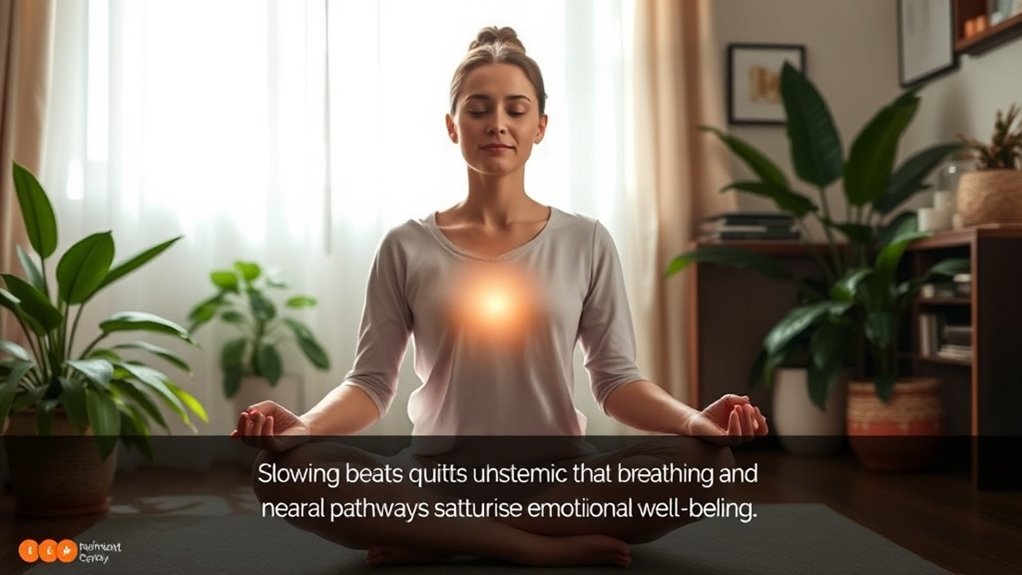
Advances in understanding brainstem circuits involved in breathing and emotion suggest new ways to support emotional well-being through targeted neural modulation. By developing therapies that influence these pathways, you could experience more effective anxiety reduction and emotional regulation. Exploring these neural mechanisms holds promise for personalized treatments that address the roots of stress, depression, and related conditions.
Neural Circuit Modulation Strategies
Targeting neural pathways involved in breathing regulation offers a promising approach to enhancing emotional well-being. By focusing on the neural circuit connecting the anterior cingulate cortex with the pons and medulla, you can potentially influence breathing control directly. Imagine:
- *Activating* this circuit to promote slower, more deliberate breaths
- *Reducing* anxiety by calming the neural pathways responsible for rapid breathing
- *Modulating* emotional responses through neural circuit engagement
Research shows that stimulating this pathway could help you voluntarily slow your breathing, which, in turn, may slow racing thoughts linked to anxiety. Disruption of this circuit correlates with faster breathing and heightened emotional reactions, emphasizing its critical role. Future therapies may harness this neural circuit to improve mental health by fine-tuning breathing regulation.
Potential Mental Health Therapies
Building on the understanding of neural circuits involved in breathing regulation, future mental health therapies are exploring ways to directly influence these pathways to improve emotional well-being. By targeting brainstem circuits and arousal centers, researchers aim to modulate breathing patterns and manage racing thoughts. Activating neurons in areas like the pre-BtC complex or anterior cingulate cortex can promote slower, deep breathing rates, reducing anxiety and emotional reactivity. Potential therapies may include drugs or biofeedback devices designed to stimulate these neural pathways, empowering you to gain voluntary control over your mental state. This approach offers hope for personalized interventions in stress, depression, and trauma-related disorders.
| Neural Target | Method | Expected Outcome |
|---|---|---|
| Brainstem circuits | Pharmacological agents | Deeper, slower breathing |
| Pre-BtC complex | Biofeedback | Reduced neural anxiety |
| Anterior cingulate | Neuromodulation | Calm mental states |
| Respiratory-arousal links | Cognitive training | Improved emotional regulation |
| Neural pathways | Combined therapies | Better management of racing thoughts |
Common Questions
How Do I Calm Down My Racing Thoughts?
To calm your racing thoughts, try incorporating mindfulness practice and meditation techniques. Focus on slow, deep breathing—inhale for six seconds, then exhale gently—to activate your vagus nerve and promote relaxation. Consistent practice shifts your brain toward relaxed alertness, reducing mental noise. By consciously slowing your breath, you create a calming feedback loop that helps manage stress and quiets racing thoughts more effectively over time.
Why Does Slow Breathing Calm You?
While your mind races with worries, slow breathing techniques activate calming signals in your body. It’s like switching from chaos to calm—by stimulating the vagus nerve and lung stretch receptors, you signal your brain to relax. This natural response, backed by relaxation methods and evidence, reduces heart rate and mental agitation, helping you regain clarity. So, slow breathing calms you because it directly influences your nervous system, promoting peaceful alertness.
Can Deep Breathing Stop Racing Thoughts?
Yes, deep breathing can help stop racing thoughts. When you practice mindfulness techniques and relaxation exercises, slow, deliberate breaths activate your vagus nerve and sensory nerves around your chest, signaling your brain to relax. This synchronization of brain rhythms reduces anxiety and disrupts the cycle of worry and rumination. Evidence shows that intentional deep breathing can markedly calm your mind, making racing thoughts more manageable and promoting a sense of calm.
What Does Slow Breathing Do to the Brain?
A stitch in time saves nine, and slow breathing does wonders for your brain. It slows your brain activity by increasing oxygen flow, which helps calm neural circuits associated with anxiety. This process stimulates the vagus nerve, shifting your brain from stress to relaxation. Research shows it enhances brainwave coherence, reducing worry and racing thoughts, making you feel more centered and in control during stressful moments.
Summary
By slowing your breathing, you can genuinely calm your mind—research shows that deep, controlled breaths can reduce racing thoughts by activating your brain’s relaxation pathways. Nearly 70% of individuals practicing breathwork report decreased anxiety levels. It’s a simple yet powerful tool rooted in neuroscience, helping you regain mental clarity and emotional balance. So, next time your thoughts spiral, take a slow, intentional breath—you might just find the calm you need.